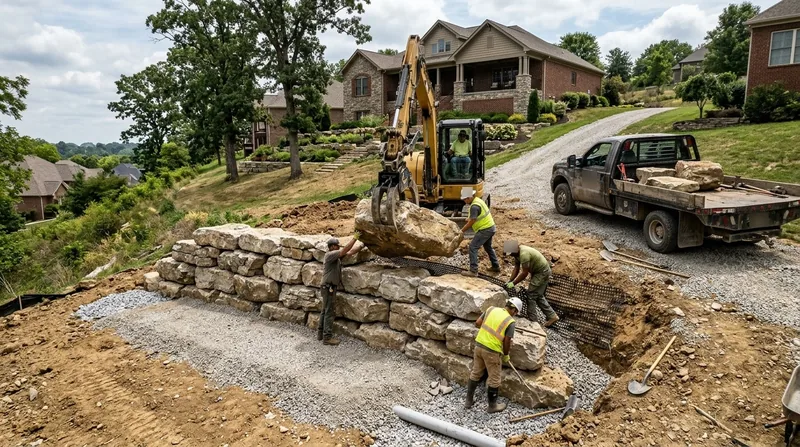




Louisville lots run from the flat Ohio River floodplain in Valley Station to the steep shale knobs around Iroquois Park and Mount Washington, and the right wall has to match that ground. Boulder & Natural Stone Walls in Louisville use heavy local limestone and machine-placed rock to hold a slope without looking like a concrete bunker dropped on the lawn. We build walls that fit the rolling karst east of downtown, the terraced Highlands yards, and the newer Oldham County subdivisions where a segmental block wall would read as too suburban. If your slope is moving or your old wall is leaning, start with leaning and collapsed wall repair before you spend money on a new face.
Why Boulder & Natural Stone Walls Matter on Louisville's Slopes and Knobs
Louisville sits on a mix of heavy silty clay and shallow limestone karst, and that clay holds water like a sponge after a spring downpour. When a wall is backfilled with the wrong material or has no drainage, the saturated soil pushes the wall out and the freeze-thaw cycle finishes the job. Boulder walls handle that pressure well because each rock is massive, well-seated, and free-draining when we build the base right.
- Heavy silty clay in the Highlands and Crescent Hill swells against walls and needs a proper gravel drainage zone behind the rock.
- Steep shale knobs near Iroquois Park and Fairdale shed water fast, so toe restraint matters more than height.
- Karst limestone east of downtown can hide voids, and we probe the footing before setting the first boulder.
- Older mortared Kentucky limestone walls in Old Louisville and Germantown often need repointing, not replacement.
Matching the rock to the ground is the difference between a wall that lasts thirty years and one that leans by the third wet spring.
Key info: A Prospect homeowner on a steep knob lot had a dry-laid limestone wall bulging 8 inches after two wet springs. We reset the toe, rebuilt the drainage gravel, and re-laid the original stone at a 1:6 batter. The wall has not moved since.
Before any wall goes in, check the local building department rules. In most Louisville-area jurisdictions a permit is required above roughly 4 feet measured from the footing, or whenever the wall carries a driveway or structure surcharge. Thresholds vary, so verify with the city or county before work starts. The Louisville Metro Codes and Regulations office is the place to confirm.
How We Build a Boulder Wall That Holds on Louisville Ground
We do not stack rock on topsoil and call it a wall. Every boulder wall starts with excavation to undisturbed soil, a compacted crushed-stone base, and a drainage plane that moves water away from the face. Then we set each rock with a machine, seat it, and batter it back into the slope so the wall leans into the hill the way a dry-laid wall should.
- We walk the slope and mark the wall line, checking for utilities and the property setback.
- We excavate to firm soil and compact a 6 to 12 inch crushed-stone base sized to the wall height.
- We install filter fabric and a gravel drainage zone with a perforated outlet at the low end.
- We set the base course of boulders, then place each rock with an excavator and seat it by hand.
- We batter the face back 1 inch per foot of height and pin key rocks where the slope demands it.
- We cap the top, backfill with free-draining gravel, and restore the planting bed above the wall.
The result is a wall that looks natural from the street and drains like a French drain behind the scenes.
Key info: In St. Matthews, a 1970s railroad tie terrace behind a ranch house had rotted through and was pushing a mudslide toward the patio. We pulled the ties, cut the slope back to stable clay, and set a 3-foot boulder wall with a gravel drain. The patio is dry and the yard is usable again. See our St. Matthews wall work for a closer look at that kind of rebuild.
Boulder and Natural Stone Wall Methods We Use in Louisville
Not every slope wants the same construction. A dry-laid boulder wall suits a planted hillside, while a mortared limestone wall suits a formal entry or a tight urban lot. We pick the method after we see the soil, the slope, and how you want the wall to read from the house.
| Approach | Description | Best for |
|---|---|---|
| Dry-laid boulder wall | Machine-placed limestone boulders stacked with a batter and a gravel drain behind the face. | Hillside terraces, planted slopes, and natural-looking landscape walls. |
| Mortared limestone wall | Kentucky limestone laid in mortar over a concrete footing with weep holes and drainage. | Formal entries, tight urban lots, and walls that need a crisp finished face. |
| Boulder toe wall | A low rock toe at the base of a steep knob slope to stop soil creep and erosion. | Steep shale slopes near Iroquois Park, Fairdale, and Mount Washington. |
| Tiered boulder terrace | Two or three shorter walls stepped back into the slope with drainage between tiers. | Tall grade changes where a single wall would need engineering. |
We choose the method that fits your slope and your budget, not the one that is easiest to sell.
Boulder & Natural Stone Walls Cost in Louisville: What to Expect
Most boulder and natural stone walls in Louisville start around $25 per square foot of wall face, and the final number depends on access, rock size, and how much excavation the slope needs. A wall you can reach with a machine and build dry-laid sits at the low end. A tight backyard in the Highlands where every rock moves by hand, or a wall that needs a concrete footing and mortar, moves up fast.
- Rock size and type change the price, since larger limestone boulders cost more per ton and need bigger equipment.
- Access matters most on steep knobs and narrow urban lots where an excavator cannot reach the wall line.
- Wall height and tiering add cost, and walls above roughly 4 feet may need engineered drawings.
- Drainage and excavation are not optional, and skipping them is how walls fail.
Get two or three written estimates on the same scope so you compare rock, drainage, and base prep, not just the bottom line. Our full pricing overview breaks down what drives the number.
What to Look For in a Retaining Wall Contractor Near Louisville
Hiring a wall contractor near Louisville comes down to proof, not promises. Ask for the license and insurance certificate, then call the references on walls at least two years old. A wall that looked good at handoff and is still straight after a few freeze-thaw cycles tells you more than any brochure.
- Confirm the contractor is fully insured, and ask for the certificate before work starts.
- Get at least three estimates with the same wall height, rock type, and drainage scope.
- Ask how they handle permits, especially on walls over 4 feet or near a property line.
- Check whether your subdivision or HOA has rules on wall materials and height.
If a bid is far below the others, ask what is missing from the base, the drainage, or the rock size. Reach out through our contact page and we will walk your slope and give you a straight answer.
Boulder & Natural Stone Walls in Louisville: Pricing Guide
| Service | Price | Details |
|---|---|---|
| Dry-laid boulder wall | Starting at $25/sq ft | Includes excavation, compacted base, filter fabric, gravel drain, and machine-placed limestone boulders. |
| Mortared limestone wall | Starting at $45/sq ft | Includes concrete footing, mortared Kentucky limestone, weep holes, and drainage behind the face. |
| Boulder toe wall or low terrace | Starting at $1,800 | Short walls under 2 feet for slope toe protection, priced by length and access. |
| Complex or large-scale job | On estimate | Tall, tiered, or engineered walls need an on-site look at soil, access, and surcharge loads. |
| Travel | Included | In Louisville and surrounding areas, no separate call-out or mileage fee. |
| Estimate | Free | Response within 24h at (502) 442-0464, no obligation to book. |
Indicative pricing, the exact cost depends on square footage, finish, and site access. Free personalized estimate within 24h at (502) 442-0464.


