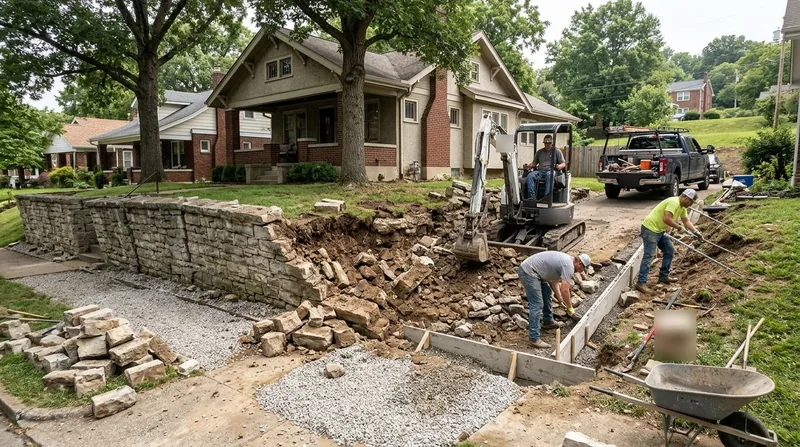




Leaning & Collapsed Wall Repair in Louisville
Louisville sits on ground that keeps walls honest. East of downtown the karst limestone rolls under the Highlands and Clifton, the shale knobs climb around Iroquois Park and Fairdale, and the silty clay in Germantown, Schnitzelburg and Shively swells every spring. When a wall starts to lean, bulge or drop a course of block, it usually means water found a path and the footing lost its grip. Leaning & Collapsed Wall Repair in Louisville is our priority call, and we respond fast to stabilize the wall before the slope above it moves. We handle tieback anchoring, drainage correction and full rebuilds on limestone, poured concrete, CMU, timber and segmental block walls. If the wall is still standing but out of plumb, call now. Visit our retaining wall repair service page for the full scope of repair work we take on.
Why Leaning Walls Are a Louisville Problem, Not a Cosmetic One
A leaning wall in Louisville is rarely just an eyesore. The heavy silty clay across the West End, Valley Station and Okolona holds water like a sponge, and after a wet March the hydrostatic pressure behind a wall can double. Add freeze-thaw cycles that push mortar joints apart, plus sinkhole-prone limestone under much of the east side, and you get the failure pattern we see most: a wall bows outward at mid-height, then drops a section after the next downpour. On the steep shale slopes near Mount Washington and Fairdale, a collapsed wall can send soil onto a driveway or patio in one storm.
- Clay soils trap water behind the wall and push it out of plumb.
- Freeze-thaw cycles crack mortar and open joints in limestone and CMU walls.
- Sinkholes and voids under footings let the base settle unevenly.
- Tree roots and creeping knob slopes add lateral load the wall was never built for.
Ignoring a lean lets a repairable wall turn into a full replacement, so we treat every out-of-plumb wall as urgent.
Key info: A 1970s railroad tie terrace in St. Matthews that leans two inches today can lose a whole tier after a heavy spring rain. We see this most on the older lots around Crescent Hill and Lyndon, where ties have rotted for decades behind the clay.
For official guidance on when a wall needs a permit or engineered drawings, check the Louisville Metro Codes and Regulations before you schedule work.
How We Stabilize and Rebuild a Failing Wall in Louisville
Every leaning wall gets the same first step: find out why it moved. We dig test pits behind the wall, check the footing, and look for water paths, root intrusion and voids in the limestone. Then we build a repair plan around the actual cause, not just the visible lean. Most jobs move through five stages, and we tell you at each one whether a repair still makes sense or a rebuild is the smarter spend.
- We inspect the wall, footing and drainage behind it, and mark the failure mode.
- We relieve hydrostatic pressure by correcting or adding drainage before we push anything back.
- We install tieback anchors or helical piers to pull a leaning wall back to plumb and hold it.
- We rebuild collapsed sections with matching block, limestone or concrete where the wall can be saved.
- We restore the slope above the wall and confirm water now runs away from the face.
You get a written scope before we start, and we do not leave an open excavation overnight on a slope above a house.
Key info: On a Prospect lot last spring, a segmental block wall had bulged four inches toward the driveway. We pulled it back with helical tiebacks, rebuilt the drainage behind it, and saved the wall for a fraction of a replacement. A full tear-out would have cost roughly three times as much.
If the wall is past saving, we move into retaining wall replacement and rebuild it right, with drainage and footing sized for the slope. Walls near the Highlands and 40217 often need a closer look at the original stone work, which you can read about on our 40217 service page.
Repair Methods We Use on Louisville Walls
Not every leaning wall needs the same fix. We match the method to the wall type, the soil and how much load the slope above is putting on it. Here is how the main approaches compare.
| Approach | Description | Best for |
|---|---|---|
| Tieback anchoring | Helical or grouted anchors pull a leaning wall back to plumb and hold it against soil pressure. | Bulging block, concrete and limestone walls that are still structurally sound. |
| Drainage correction | We add footing drains, weep holes and gravel backfill to relieve hydrostatic pressure. | Walls that lean after spring rain, common on clay lots in Shively and Okolona. |
| Partial rebuild | We remove and reset collapsed courses with matching block, stone or concrete. | Walls with one failed section and a sound footing elsewhere. |
| Full rebuild with new footing | We tear out the failed wall and build a new one sized for the slope and soil. | Collapsed walls, rotted timber and railroad tie terraces, and walls on steep knobs. |
We pick the least invasive method that will actually hold, and we tell you when a repair will not last.
Leaning & Collapsed Wall Repair Cost in Louisville: What to Expect
Most leaning and collapsed wall repairs in Louisville start at From $2,500, which covers stabilization, drainage correction and a partial rebuild on a typical residential wall. The number moves with the wall type, how much soil is behind it, and how much of the wall has failed. A short tieback job on a block wall in Lyndon sits near that starting figure. A collapsed limestone wall on a steep knob in Mount Washington, with limited machine access, runs higher.
Four things drive the price: the wall height and length, the soil and water problem behind it, access for equipment, and whether the wall carries a surcharge like a driveway or structure. Walls over roughly four feet, or walls holding up a driveway, may need a permit and engineered drawings, which adds design cost. Getting two or three written estimates is the smart move, because a contractor who skips the drainage diagnosis will quote low and the wall will lean again next spring.
Our full pricing overview breaks down what each repair scope includes so you can compare bids on the same footing.
Leaning & Collapsed Wall Repair Near Me: How to Hire in Louisville
When you search for leaning and collapsed wall repair near me, you will get a long list of names. Narrow it with a few checks before anyone touches the wall. Ask for proof of license and insurance, and get the certificate sent to you, not just a verbal yes. Get two or three estimates in writing and compare the drainage scope, not just the price. Call references on jobs similar to yours, especially older limestone or railroad tie walls. And confirm who pulls the permit if your wall is over the local threshold or supports a driveway. If your property is in an HOA, check the rules on wall materials and color before you approve a rebuild.
Reach out through our contact page to set up a free estimate, or call (502) 442-0464 and we will get a crew out to look at the lean.
Leaning & Collapsed Wall Repair in Louisville: Pricing Guide
| Service | Price | Details |
|---|---|---|
| Drainage correction and stabilization | Starting at $2,500 | Covers pressure relief, weep holes, gravel backfill and minor resetting on a typical residential wall. |
| Tieback anchor repair | Starting at $3,800 | Helical or grouted anchors pull a bulging block or concrete wall back to plumb and hold it. |
| Partial rebuild of a collapsed section | Starting at $4,500 | Removes and resets failed courses with matching material; wall height and access move the number. |
| Full rebuild with new footing | On estimate | Collapsed or rotted walls need an on-site look at soil, slope and surcharge before we quote. |
| Travel | Included | in Louisville and surrounding areas, no separate call-out or mileage fee |
| Estimate | Free | Response within 24h at (502) 442-0464, no obligation to book |
Indicative pricing, the exact cost depends on square footage, finish, and site access. Free personalized estimate within 24h at (502) 442-0464.


