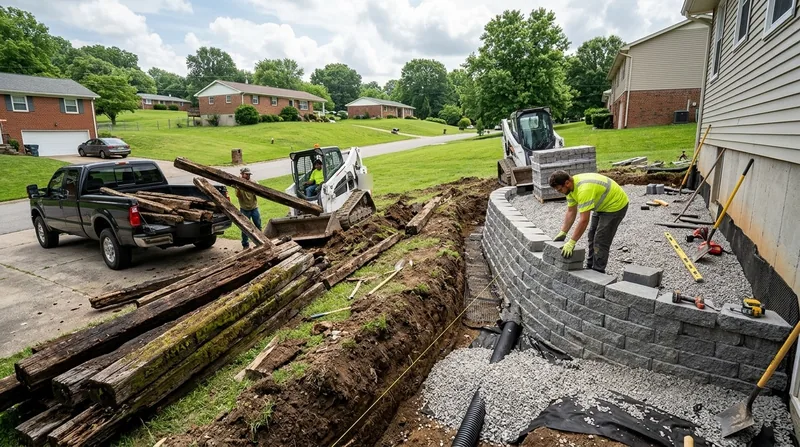




Louisville lots run from the flat Ohio River floodplain in the West End and Valley Station to the rolling karst east of downtown and the steep shale knobs around Iroquois Park, Fairdale, and Mount Washington. On that ground, a lot of 1970s and 1980s railroad tie terraces are still holding up hillsides behind ranches in Shively and Okolona, split-levels in the East End, and bungalows in the Highlands. Most of those walls are now leaning, rotting, or pushing out at the base. Railroad Tie Wall Replacement in Louisville means pulling the old creosote ties, hauling them off, and rebuilding the wall in segmental block, poured concrete, or Kentucky limestone with proper gravel backfill and drainage. We handle the demolition, the disposal, and the rebuild, and we keep the wall where it belongs so your yard stops sliding. If your wall is still standing but cracked or bowed, start with leaning and collapsed wall repair before the whole thing comes down.
Why Railroad Tie Walls Are Failing All Over Louisville
Creosote-treated ties were cheap and easy in the 70s, and thousands went in across Jefferson, Oldham, and Bullitt counties. Forty years later, the wood is the problem. Louisville's heavy silty clay holds water against the tie faces, freeze-thaw cycles work the joints open, and spring downpours push water through a wall that was never built with gravel drainage. Add sinkhole-prone limestone under some of these lots and creeping knob slopes, and a tie wall that looked fine in 1995 is now a safety issue.
- Rotted ties lose their structural strength and start bowing or snapping under the soil load.
- Creosote leaches into the soil and can stain driveways, patios, and nearby planting beds.
- Missing or clogged drainage lets silty clay water build pressure behind the wall until it pushes out.
- Failed ties invite termites and carpenter ants close to the house, especially on older Germantown and Schnitzelburg lots.
- Weathered tie walls drag down curb appeal and can complicate a home inspection or sale.
When a tie wall starts moving, the fix is replacement, not another coat of stain. Louisville Metro's building department sets the permit thresholds for walls over roughly 4 feet or walls that carry a driveway or structure, and you can verify current rules at Louisville Metro Codes and Regulations.
Key info: A Prospect homeowner called us about a 1982 tie wall holding up a driveway. Three courses had rotted through and the asphalt was cracking. We rebuilt it in segmental block with a geogrid-reinforced gravel column, and the driveway has stayed put through two freeze-thaw seasons.
How We Replace a Railroad Tie Wall in Louisville
Every replacement starts with a site visit, because the right answer on a flat Shively lot is different from the right answer on a knob slope in Mount Washington. We look at soil, drainage, wall height, and what the wall is holding up. Then we price the demo, the haul-away, and the rebuild in one scope so there are no surprise charges halfway through. If the wall is only partly failing, we tell you that too.
- We mark utilities and confirm the wall line, height, and what sits above it.
- We tear out the old ties, cut them to manageable lengths, and haul them to a permitted disposal site.
- We excavate to the footing and shape the base on compacted gravel, not on bare clay.
- We install drainage stone, filter fabric, and perforated pipe to move water away from the wall.
- We build the new wall in segmental block, poured concrete, or natural limestone, with geogrid where the height or load calls for it.
- We backfill in lifts, compact each one, and finish the grade so runoff goes around the wall, not through it.
For a wall that also needs slope work above or below it, we bring in slope stabilization and erosion control so the ground behind the new wall stays where it belongs.
Key info: On a St. Matthews lot off Shelbyville Road, the old tie wall was holding a raised patio. We staged the demo so the patio stayed usable, rebuilt in block, and tied the new drainage into the existing downspouts. The homeowner never lost access to the back door.
Replacement Options: Block, Concrete, or Kentucky Limestone
Once the ties are out, you have real choices, and the right one depends on height, load, budget, and how the wall needs to look against the house. A 2-foot garden terrace in Lyndon and a 6-foot driveway wall in Anchorage do not call for the same system. We walk you through the trade-offs before anything gets ordered.
| Approach | Description | Best for |
|---|---|---|
| Segmental block | Interlocking concrete units with gravel backfill and geogrid on taller walls. | Terraces and driveway walls in Middletown and Jeffersontown subdivisions. |
| Poured concrete | Cast-in-place wall with rebar and a formed face, built for heavy loads. | Tall walls, driveway surcharges, and tight lots where space is limited. |
| Natural limestone | Kentucky limestone laid dry or mortared to match the local stone look. | Visible garden walls and older homes in the Highlands and Crescent Hill. |
| Boulder and rock | Large natural stone set into the slope for a softer, rustic face. | Knob slopes around Iroquois Park and Fairdale where grades are steep. |
Whichever material you pick, the drainage behind it matters as much as the face you see. We build every replacement with that in mind.
Railroad Tie Wall Replacement Cost in Louisville: What to Expect
Most railroad tie wall replacements in Louisville start around $35 per square foot of wall face, and that figure moves with height, access, and material. A low terrace wall in Shively with a straight truck approach sits near the bottom of that range. A tall wall on a tight Highlands lot, or one holding a driveway in Prospect, runs higher because of excavation, haul-off, and engineering. Creosote ties also cost more to dispose of than clean fill, and that gets priced in.
Get two or three written estimates and compare scope, not just the bottom line. One bid may skip drainage or geogrid, and that is exactly where a cheap wall fails in five years. Our full pricing overview breaks down what drives the number so you can read a bid with confidence.
Railroad Tie Wall Replacement Near Me: How to Pick a Contractor Near Louisville
Hiring for a tie wall replacement near Louisville comes down to a few checks that take ten minutes. Ask for the license and insurance certificate, confirm the company has pulled permits for walls like yours, and call two recent references in Jefferson or Oldham County. A contractor who has rebuilt walls on your kind of soil will talk about drainage and backfill without being prompted.
Also ask who handles the creosote tie disposal and whether the estimate includes haul-away. Get the scope in writing, including wall height, material, drainage, and cleanup. If you are ready for a site visit, contact us for a free estimate and we will look at the wall, the slope, and the access before we quote a number.
Railroad Tie Wall Replacement in Louisville: Pricing Guide
| Service | Price | Details |
|---|---|---|
| Railroad tie wall replacement, standard access | Starting at $35/sq ft | Includes tie demolition, haul-away, gravel backfill, drainage, and rebuild in segmental block on a typical lot. |
| Replacement with natural limestone or boulder face | Starting at $48/sq ft | Covers stone selection and setting; price rises with wall height, stone size, and tight truck access. |
| Tall or loaded wall (driveway or structure above) | On estimate | Walls over roughly 4 feet or carrying a surcharge need an on-site look, soil review, and possible engineered drawings. |
| Drainage and geogrid upgrade | Quoted with the wall | Adds perforated pipe, filter fabric, and geogrid where height or soil conditions call for reinforcement. |
| Travel | Included | In Louisville and surrounding areas, no separate call-out or mileage fee. |
| Estimate | Free | Response within 24h at (502) 442-0464, no obligation to book. |
Indicative pricing, the exact cost depends on square footage, finish, and site access. Free personalized estimate within 24h at (502) 442-0464.


