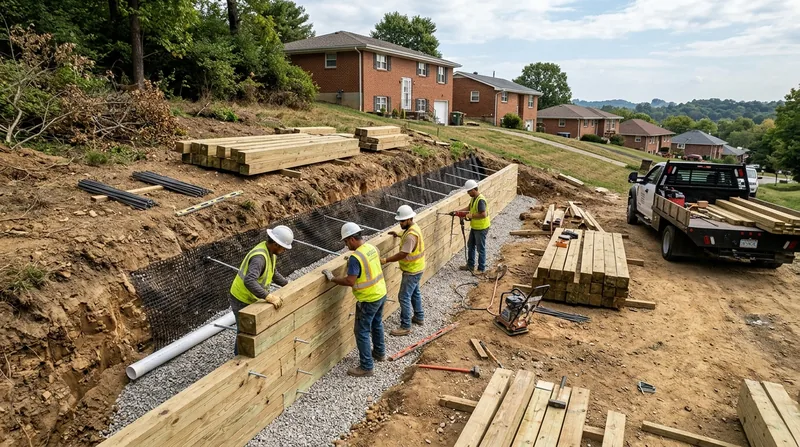




Timber Retaining Walls in Louisville are the budget-friendly choice for garden beds, low terraces, and short grade changes, and we build them with pressure-treated lumber sized for the job. This city sits on heavy silty clay that holds water, freeze-thaw cycles that push on every wall, and karst limestone that can open up under a footing. From the rolling streets of the Highlands and Crescent Hill down to the shale knobs around Iroquois Park and Mount Washington, timber works well when the wall stays low and drains properly. We tell homeowners straight: timber is a 10 to 15 year material here, and it earns its keep on beds and low terraces, not on tall structural walls. If you need a wall that carries a driveway or holds a steep knob slope, we point you to retaining wall installation in a longer-lasting material.
Why Timber Walls Fail Fast in Louisville Clay and Freeze-Thaw
The dominant failure mode in Louisville is water. Our silty clay swells when wet and shrinks when dry, and it does not drain on its own. A timber wall backfilled with that clay and no gravel behind it will bow, lean, and rot at the base within a few seasons. Add the freeze-thaw cycles we get from December through March and the pressure on the boards doubles.
- We dig below the frost line so the base course does not heave out of the ground.
- We set every timber on a compacted gravel footing, never bare clay.
- We backfill with washed stone and wrap it in filter fabric so fines stay out of the drainage zone.
- We install weep holes or a perforated drain pipe to give the water somewhere to go.
- We use ground-contact rated pressure-treated lumber, not landscape timbers sold for edging.
Skip any one of those steps and the wall will tell you about it in two winters. The local building department sets the permit threshold, and it is worth reading before you dig: Louisville Metro Codes and Regulations covers the permit rules for walls that hold a surcharge.
Key info: A timber wall in Shively that we rebuilt in 2023 had been backfilled with straight clay and no drain. The bottom two courses were rotted through and the face was leaning 4 inches. We pulled it, reset the footing, added gravel and fabric, and the replacement has not moved.
How We Build a Timber Wall That Lasts in Louisville
We treat a timber wall like any other retaining structure, just with a shorter service life and a smaller budget. The steps below are what we actually do on site, in order, from the first walk-through to the final backfill. If the wall is a low garden bed in St. Matthews, it takes a day. If it is a tiered terrace on a knob slope out toward Prospect, it takes longer.
- We walk the site and check the slope, the soil, and where water runs during a spring downpour.
- We call 811 to mark utilities before any digging starts.
- We excavate to the footing depth and compact a gravel base that sits below the frost line.
- We set the first course level and dead-straight, because every course above it follows that line.
- We tie the courses with galvanized spikes or deadmen so the wall cannot push forward.
- We install drainage stone, filter fabric, and a drain path behind the wall.
- We backfill in lifts and compact each one before the next goes in.
Every step matters on Louisville clay, and the drainage steps matter most. You can see how we handle water on a failing wall on our retaining wall drainage page.
Key info: In Jeffersontown we built a 3-foot timber terrace behind a 1970s split-level where the yard fell away from the house. We set deadmen every 4 feet, ran a perforated drain to daylight at the side lot line, and the homeowner gained a flat planting bed without touching the house footing.
Timber Wall Approaches We Use on Louisville Lots
Not every Louisville yard calls for the same build. A flat lot in Okolona and a steep shale slope in Fairdale need different answers, and the table below shows how we match the approach to the site. We pick the method after we see the grade, the soil, and how much water the wall will have to handle.
| Approach | Description | Best for |
|---|---|---|
| Single-course timber bed | One or two courses of 6x6 pressure-treated timber on a gravel footing, no structural load. | Garden beds and low edging under 18 inches. |
| Tiered timber terrace | Stacked courses stepped back into the slope, each tier drained separately. | Yards that drop 2 to 4 feet across the lot. |
| Deadman-anchored wall | Timbers tied back into the hillside with deadmen and spikes to resist overturning. | Walls 2 to 4 feet high on clay or knob slopes. |
| Timber to block upgrade | We swap rotted timber for segmental block when the wall has to last decades. | Structural walls, driveway edges, and tall grades. |
If your wall is already leaning or the base is gone, that is a repair conversation, not a new build. Our leaning and collapsed wall repair page covers what we can save and what has to come out.
Timber Retaining Walls Cost in Louisville: What to Expect
Timber Retaining Walls cost in Louisville starts around $20 per square foot of wall face for a basic single-course bed, and the price moves from there. A 3-foot tiered terrace with deadmen, drainage stone, and fabric runs higher per square foot than a 12-inch garden edge. Access matters too: a wall you can reach with a truck and a wheelbarrow is cheaper than one tucked behind a Highlands bungalow with no alley.
Length of run, height, soil conditions, and whether we have to remove an old railroad tie wall all change the number. Rotting ties from the 1970s and 1980s are common across Shively, Okolona, and the East End, and pulling them costs money before the new wall goes in. We give you a written scope so you can compare bids line by line. Our full pricing overview breaks down the ranges, and we always recommend two or three estimates on any wall over a few hundred dollars.
Timber Retaining Walls Near Me: How to Vet a Contractor Near Louisville
When you search for timber retaining walls near me, the list you get is mostly whoever pays for ads. Use the checklist below to sort the real builders from the lead brokers. A contractor who cannot answer these questions before you sign is a contractor who will disappear when the wall leans.
- Get two or three written estimates that list materials, drainage, and disposal separately.
- Ask for references from walls at least two years old, not just last month's job.
- Confirm who pulls the permit if your wall crosses the local height or surcharge threshold.
- Check HOA rules in subdivisions out toward Middletown and Prospect before you pick a material.
A wall is only as good as the drainage behind it, so ask every bidder how they handle water. If the answer is vague, move on. You can reach us through our contact page for a free estimate, and we will tell you honestly if timber is the wrong call for your site.
Timber Retaining Walls in Louisville: Pricing Guide
| Service | Price | Details |
|---|---|---|
| Single-course timber garden bed | Starting at $20/sq ft | Includes gravel footing, pressure-treated timber, and basic backfill for low beds. |
| Tiered timber terrace | Starting at $32/sq ft | Adds deadmen, drainage stone, filter fabric, and stepped courses for grade changes. |
| Timber wall replacement | Starting at $28/sq ft | Covers removal of rotted ties or timber plus new footing and drainage. |
| Complex or tall wall | On estimate | Walls over 4 feet, surcharge loads, or tight access need an on-site look first. |
| Travel | Included | In Louisville and surrounding areas, no separate call-out or mileage fee. |
| Estimate | Free | Response within 24h at (502) 442-0464, no obligation to book. |
Indicative pricing, the exact cost depends on square footage, finish, and site access. Free personalized estimate within 24h at (502) 442-0464.


