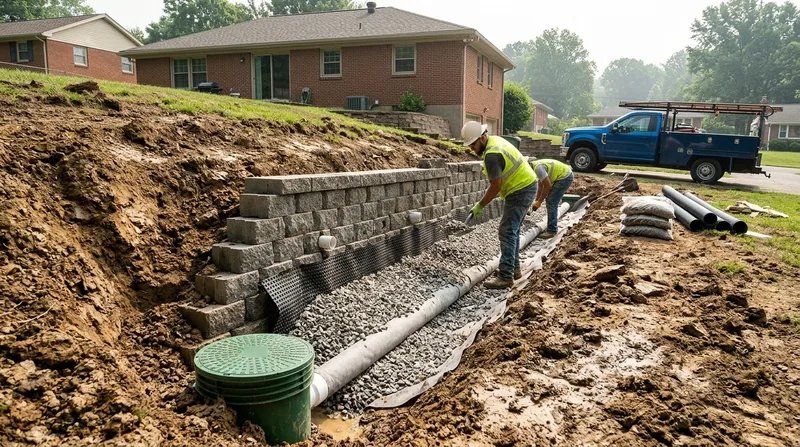




Retaining Wall Drainage in Louisville: Keep Water From Taking Your Wall Down
Louisville sits on ground that punishes a bad wall. The silty clay east of downtown holds water like a sponge, the shale knobs around Iroquois Park and Mount Washington shed it fast, and the freeze-thaw swings of a Kentuckiana winter work whatever is trapped behind your wall until something gives. If your wall is bulging, weeping through the face, or listing toward the driveway, the problem is almost never the block. It is the water. Retaining Wall Drainage in Louisville is the work that relieves that pressure before the wall pays for it.
We install French drains, weep holes, gravel backfill, and waterproofing on walls all over the city, from limestone terraces in the Highlands to railroad tie walls behind Valley Station ranches. If the wall is already moving, start with leaning and collapsed wall repair and we will tell you straight whether drainage saves it or the wall needs to come out.
Why Drainage Decides Whether a Louisville Wall Lasts
Hydrostatic pressure is the number one killer of retaining walls in this city. When clay soil saturates and cannot drain, the water pushes against the back of the wall with thousands of pounds of force it was never built to carry. Add a January freeze and that saturated clay expands, then drops, then expands again, and the wall shifts a little more each season.
- Silty clay in Shively, Okolona, and the East End holds water for days after a spring storm.
- Karst limestone east of downtown lets water move underground and surface right at a wall footing.
- Steep knob slopes around Fairdale and Mount Washington send runoff down onto walls below.
- Old mortared limestone walls in Old Louisville and Germantown have no weep holes at all.
- Aging railroad tie terraces from the 70s and 80s rot fast once water sits behind them.
Every one of those failure modes is a drainage problem first and a structural problem second. Fix the water and most walls stop moving.
Key info: A mortared limestone wall on a Crescent Hill terrace we inspected last spring had a visible bulge and water staining on the face. The wall was sound. The clay behind it was not draining, and a French drain plus new weep holes stopped the movement without rebuilding a single course.
For the code side of wall heights and permits, check the Louisville Metro Codes and Regulations before you build or modify anything structural.
How We Install Retaining Wall Drainage on Louisville Lots
We start by finding out where the water actually goes, not where the homeowner assumes it goes. On karst ground the answer is often surprising. Then we open the wall, correct the grade, and build a drainage path that still works in ten years.
- We walk the lot and trace runoff, downspouts, and any springs or sinkhole activity.
- We excavate behind the wall to the footing and clear out failed clay and rotted timber.
- We line the trench with filter fabric so silt does not clog the drain.
- We set perforated pipe at the correct fall and daylight it or tie it to a storm line.
- We backfill with washed gravel, not the clay we pulled out.
- We cut or restore weep holes at the base and keep them clear of soil.
- We waterproof the wall face where the wall is below grade or holds a surcharge.
- We compact and regrade the surface so water sheds away from the wall, not into it.
On block walls in Middletown and Prospect we also check the geogrid and cap while the wall is open, because drainage work is the cheapest moment to fix anything else that is tired.
Key info: A homeowner in Jeffersontown had water pouring out of the face of a segmental block wall every time it rained. The wall had no drain and the gravel behind it was packed with clay fines. We rebuilt the drain, replaced the backfill, and the wall has stayed dry and straight through two winters. See our Jeffersontown drainage work for the same setup.
Drainage Methods We Use on Louisville Walls
Not every wall needs the same fix. A poured concrete wall along an alley in Schnitzelburg and a boulder wall on a knob in Anchorage have different problems, and we match the method to the wall and the soil.
| Approach | Description | Best for |
|---|---|---|
| French drain behind the wall | Perforated pipe in washed gravel, wrapped in filter fabric, daylighted downhill. | Segmental block and poured concrete walls holding back clay. |
| Weep holes | Openings at the base of the wall that let trapped water escape the face. | Mortared limestone, CMU, and older concrete walls with no drainage. |
| Gravel backfill with filter fabric | Replaces water-holding clay with free-draining stone that stays clean. | Any wall being rebuilt or opened for repair. |
| Surface waterproofing | Membrane or coating on the wall face below grade. | Walls below grade or holding a driveway surcharge. |
| Grading and downspout control | Regrade the surface and route roof water away from the wall. | Walls at the bottom of a slope or under a roof line. |
Most jobs combine two or three of these. A drain without grading still fails, and grading without a drain just moves the problem.
Retaining Wall Drainage Cost in Louisville: What to Expect
Drainage work starts at From $2,500 for a straightforward French drain and backfill on a residential wall. That figure covers a typical 20 to 30 foot wall with reasonable access, and it is the honest starting point rather than a teaser.
Several things push the number up. Access is the big one. A wall behind a Highlands bungalow with a narrow side yard and a fence in the way costs more to open than a wall along a wide driveway in Lyndon. Depth matters, because a tall wall holding back a surcharge needs more excavation and more gravel. Soil conditions matter, since karst ground can turn a simple trench into a careful dig. And if the drain has to tie into a storm line or daylight a long distance, that adds pipe and labor.
We recommend two or three estimates on any drainage job. It is the only way to compare scope, and a low bid that skips the filter fabric or the gravel is not saving you money. Our full pricing overview breaks down what each scope includes.
Retaining Wall Drainage Near Me: How to Pick a Contractor Near Louisville
Drainage is invisible work, which means it is easy to sell badly. Ask hard questions before you sign anything.
- Confirm the contractor is fully insured in Kentucky, and ask for the certificate.
- Get two or three written estimates and compare the scope line by line, not just the total.
- Ask for references on drainage jobs in your part of town, not just wall builds.
- Find out who handles permits if the wall is over the local height threshold or holds a surcharge.
- Check HOA rules in newer Oldham and Bullitt County subdivisions before any excavation.
A contractor who cannot explain where the water will go has not thought about your wall. Call us at (502) 442-0464 or request a free estimate and we will walk the lot with you.
Retaining Wall Drainage in Louisville: Pricing Guide
| Service | Price | Details |
|---|---|---|
| French drain and gravel backfill | Starting at $2,500 | Typical 20 to 30 foot residential wall, includes pipe, filter fabric, washed gravel, and regrading. |
| Weep holes and face drainage | Starting at $2,500 | Cutting and restoring weep holes on mortared limestone, CMU, or older concrete walls. |
| Full drainage rebuild with waterproofing | On estimate | Excavation to footing, membrane, new drain, and backfill on tall or surcharge walls. |
| Travel | Included | In Louisville and surrounding areas, no separate call-out or mileage fee. |
| Estimate | Free | Response within 24h at (502) 442-0464, no obligation to book. |
Indicative pricing, the exact cost depends on square footage, finish, and site access. Free personalized estimate within 24h at (502) 442-0464.


