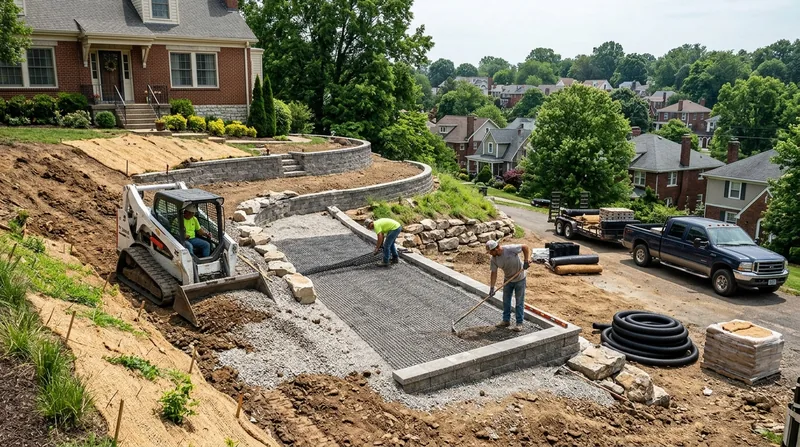




Louisville sits on a split personality of terrain. West of downtown, the Ohio River floodplain lays flat through Valley Station and the West End. East of I-65, the ground rolls over karst limestone and shale knobs, and that is where Slope Stabilization & Erosion Control in Louisville earns its keep. The steep backyards around Iroquois Park, Fairdale, and Mount Washington shed silty clay and water every spring. The cut-and-fill lots in Prospect and Anchorage hold heavy soils against walkout basements. When a knob slope starts creeping or a creek bank undercuts a fence line, the fix is engineered, not cosmetic. We build terraced walls, set geogrid, and control water before the hillside takes the driveway with it. If your slope is already moving, start with retaining wall repair to stop the failure at the source.
Why Louisville Hillsides Fail and What That Means for Your Yard
The dominant failure mode here is not wind or frost heave alone. It is heavy silty clay that holds water against a wall face, then expands and contracts through freeze-thaw cycles from December into March. Add spring downpours that dump two inches in an afternoon and you get saturated soil pushing on a wall that was never drained. The shale knobs around Iroquois Park and Mount Washington creep slowly, and the limestone karst east of downtown can open a void under a footing overnight.
- Louisville's silty clay holds moisture and loads the back of a wall far beyond what dry soil does.
- Freeze-thaw cycles open joints in mortared limestone and crack poured concrete along alley walls.
- Spring downpours overwhelm undersized drainage and saturate the slope behind segmental block walls.
- Karst limestone east of I-65 creates sinkhole risk that undermines footings without warning.
- Aging railroad tie terraces from the 1970s and 1980s are rotting out across Shively and Okolona.
Every one of those conditions is fixable, but only if the repair addresses water and soil pressure, not just the visible wall face.
Key info: A Highlands bungalow on a steep cut lot off Bardstown Road had a 3-foot dry-laid limestone wall that bulged every spring. The wall was fine. The missing drain tile behind it was the problem. We rebuilt the drainage and the wall has held through three freeze-thaw seasons.
For official guidance on when a slope project crosses into permitted work, check the Louisville Metro Codes and Regulations before you dig.
How We Stabilize a Louisville Slope, Step by Step
We start by reading the slope, not by quoting a wall. On a knob slope in Mount Washington or a creek bank in Prospect, the first question is where the water goes and how deep the unstable soil runs. We probe the soil, check for karst voids, and look at what is uphill. Then we design the fix around the actual load, not a rule of thumb.
- We walk the slope and map the water path, soil depth, and any existing wall or footing.
- We probe for karst voids and soft clay layers that would undermine a new footing.
- We design a terraced layout with geogrid reinforcement set in compacted lifts.
- We install drainage behind the wall before any block or stone goes in.
- We build the wall in lifts, compacting and testing as we go.
- We seed, mat, or stone the disturbed slope to stop surface erosion.
The sequence matters. A wall built before the drainage is a wall that fails in the first wet spring.
Key info: On a split-level lot in Middletown, the backyard dropped 9 feet to a creek. We terraced it with two segmental block walls, set geogrid every other course, and daylighted the drain to the creek. The homeowner got a usable lawn and the creek bank stopped sloughing.
If your slope drains poorly, pair the stabilization work with dedicated retaining wall drainage so water never loads the wall again.
Slope Stabilization Methods We Use in Louisville
No single approach fits every Louisville lot. A flat floodplain yard in Valley Station needs different work than a shale knob in Fairdale. We match the method to the soil, the slope angle, and what sits above and below the failure.
| Approach | Description | Best for |
|---|---|---|
| Terraced segmental block walls | Two or more stepped walls with geogrid reinforcement and drain rock behind each face. | Long residential slopes in Prospect, Anchorage, and Mount Washington. |
| Geogrid-reinforced soil | Layers of high-tensile geogrid tie the wall face back into stable soil. | Tall walls and slopes carrying a driveway or structure surcharge. |
| Boulder toe and rock slope protection | Large natural stone set at the toe to resist scour and slope movement. | Creek banks and steep shale knobs around Iroquois Park and Fairdale. |
| Surface erosion control | Seed, erosion mat, and stone channels to move runoff without cutting gullies. | Any disturbed slope after construction, especially on silty clay. |
| Underdrain and daylight systems | Perforated pipe in drain rock that carries groundwater to a safe outlet. | Wet slopes and any wall holding back Louisville's heavy clay. |
Most Louisville jobs combine two or three of these methods, because water and soil pressure rarely show up alone.
Slope Stabilization & Erosion Control Cost in Louisville: What to Expect
Every slope job starts with a free estimate, and that estimate is the only honest starting point. Louisville pricing swings widely because a 3-foot garden wall on flat ground in Lyndon and a 12-foot terraced wall on a knob in Mount Washington share almost nothing. The soil, the access, and the water decide the number.
- Slope height and length drive the wall square footage and the amount of geogrid and drain rock.
- Soil conditions matter: karst voids or deep soft clay require over-excavation and structural fill.
- Access limits equipment, and a backyard reachable only by hand costs more than a driveway-side slope.
- Proximity to structures raises the engineering and shoring requirements on any tall wall.
- Drainage scope, including underdrain, outlets, and surface work, is often 20 to 30 percent of the job.
Get two or three estimates and compare the scope, not just the bottom line. A low bid that skips drainage is a redo waiting to happen. Our full pricing overview breaks down how we build the number.
Hiring a Retaining Wall Contractor Near Me in Louisville: What to Check
Louisville has plenty of crews who will stack block on a slope. Far fewer will probe for karst, design the drainage, and pull a permit when the wall crosses the local threshold. Ask direct questions before you sign anything.
- Confirm the contractor is fully insured, and ask for a certificate of insurance before work starts.
- Get at least three written estimates that list drainage, geogrid, and excavation as separate line items.
- Ask for references from jobs on similar slopes in Louisville, not just flat-lot walls.
- Check with Louisville Metro Codes and your local building department on permit thresholds for walls over roughly 4 feet or walls supporting a surcharge.
- Review HOA rules in Prospect, Anchorage, and newer Oldham County subdivisions before you pick materials.
When you are ready to talk through your slope, contact us and we will walk the property with you.
Slope Stabilization & Erosion Control in Louisville: Pricing Guide
| Service | Price | Details |
|---|---|---|
| Slope assessment and stabilization plan | Free estimate | On-site walk, soil probe, and written scope with drainage and wall layout included |
| Terraced segmental block wall with geogrid | Starting at $45 per sq ft | Face area pricing includes geogrid, drain rock, and underdrain; slope height and access move the rate |
| Boulder toe and rock slope protection | Starting at $55 per sq ft | Natural stone set at the toe; stone size, haul distance, and creek access affect the final number |
| Surface erosion control and seeding | Starting at $3 per sq ft | Seed, erosion mat, and stone channel work; disturbed area and slope angle drive the total |
| Complex or large-scale slope job | On estimate | Karst voids, structural surcharge, or engineered drawings require an on-site look before pricing |
| Travel | Included | in Louisville and surrounding areas, no separate call-out or mileage fee |
| Estimate | Free | Response within 24h at (502) 442-0464, no obligation to book |
Indicative pricing, the exact cost depends on square footage, finish, and site access. Free personalized estimate within 24h at (502) 442-0464.


