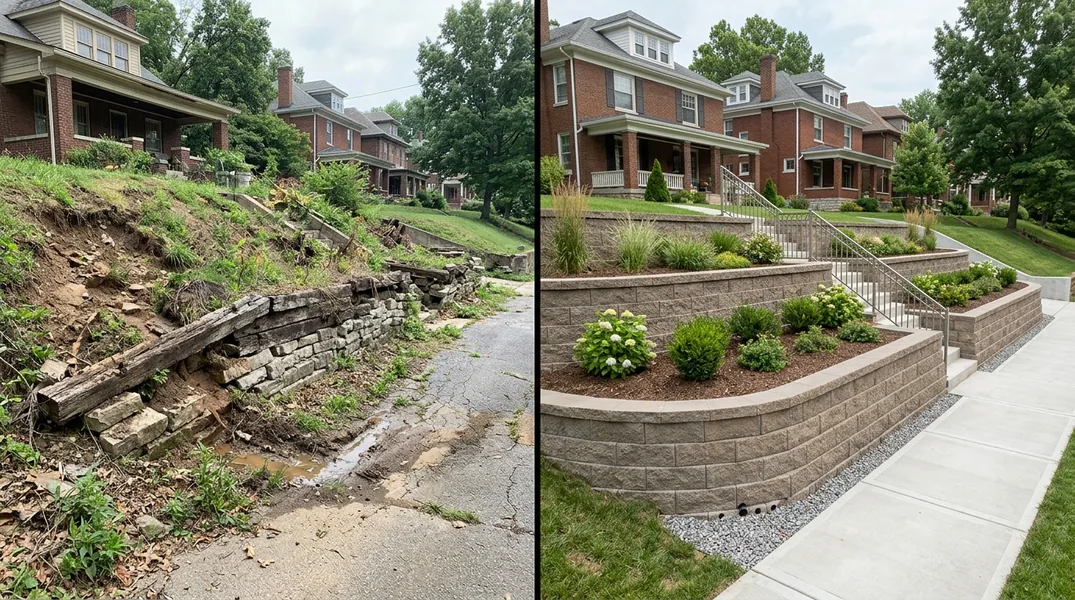
Why Louisville's Clay Soil and Freeze-Thaw Winters Demand the Right Materials
Homeowners in Louisville face a one-two punch that many retaining walls in drier or warmer climates never have to handle. The region's heavy clay soil expands when wet and shrinks when dry, pushing and pulling on wall structures season after season. On top of that, Louisville's freeze-thaw cycles mean water trapped in soil and wall joints can freeze overnight, expand, and then thaw, loosening mortar and shifting blocks over time.
That combination is why material choice matters so much here. A wall that performs beautifully in sandy Arizona soil may crack or lean within a few winters in Kentucky. The best materials for this area are those that drain well, resist frost movement, and can flex slightly without failing. Below, we break down the top options so you can walk into your project with realistic expectations and better questions for your contractor.
Block Retaining Walls: The Local Workhorse
Block retaining walls are among the most popular choices for Louisville homeowners, and for good reason. Modern block systems are engineered with interlocking features and built-in drainage channels that help manage hydrostatic pressure from saturated clay. Because they are dry-stacked or pinned rather than fully mortared, they can tolerate minor movement from freeze-thaw cycles without catastrophic cracking. They also come in a wide range of colors and textures, so they can complement everything from a modest ranch home to a brick colonial.
When properly installed with a compacted gravel base and a drainage system, a block wall can last decades. The key is installation quality: a shallow or poorly compacted base is the number one cause of leaning block walls in this region. If you are comparing options, ask your contractor how they handle base preparation and backfill drainage, because those details matter more than the block brand itself. For homeowners who want a proven, cost-effective solution, block remains a strong starting point. You can review typical project pricing to see how it fits your budget.
Concrete Retaining Walls: Strength for Taller and Heavier Loads
When a wall needs to hold back a significant slope, support a driveway, or handle heavy surcharge loads, Concrete Retaining Walls are often the right call. Poured concrete offers exceptional compressive strength and can be reinforced with steel to resist the lateral pressure that clay soil generates when it swells. For tall walls or walls carrying structural loads, concrete is frequently the most reliable long-term choice.
Concrete does have tradeoffs. It is less forgiving of settlement than segmental systems, so proper footing design and soil preparation are critical. It also requires control joints and a well-planned drainage system to manage water behind the wall. In freeze-thaw climates, air-entrained concrete mixes and proper curing help improve durability. If your project involves a tall wall or one that supports something heavy above it, a concrete design is worth discussing with an engineer or experienced installer. To talk through whether concrete fits your site, you can request a free estimate and get a professional assessment.
Segmental Retaining Walls: Flexibility That Handles Movement
Segmental retaining walls use modular units that stack and interlock without mortar, creating a flexible structure that can accommodate slight ground movement. That flexibility is a real advantage in Louisville's expansive clay, where some seasonal shifting is almost inevitable. Instead of cracking like a rigid wall might, a segmental system can move slightly and settle back into place. Many segmental units also feature a split-face or textured finish that mimics natural stone.
These walls are commonly used for terracing, garden beds, and mid-height structural walls. Their performance depends heavily on proper geogrid reinforcement and gravel backfill, especially on sloped sites. Homeowners in neighborhoods like St. Matthews often choose segmental walls for their balance of aesthetics, durability, and reasonable cost. If an existing segmental wall is bulging or settling, a Retaining Wall Repair assessment can determine whether it can be stabilized or should be rebuilt.
Limestone Retaining Walls: Natural Beauty With Local Character
Limestone is a natural fit for Kentucky, and a Retaining Wall Installation using limestone can deliver a look that feels at home in the local landscape. Limestone walls are typically built from stacked or cut stone and offer excellent mass and durability. They suit garden walls, low terracing, and decorative features where appearance matters as much as function.
Limestone does require thoughtful design in freeze-thaw conditions. Natural stone absorbs some moisture, and repeated freezing can gradually wear joints or loosen stacked units if drainage is poor. A properly built limestone wall includes a gravel base, good backfill drainage, and, where needed, mortar or pinning suited to the climate. For homeowners in areas like Shively who want a wall that looks established and natural, limestone is worth considering, provided it is installed with local weather in mind.
Retaining Wall Installation Near Me: Choosing the Right Material and Pro
There is no single best material for every Louisville yard. A low garden wall may be perfect in block or limestone, while a tall structural wall holding back a slope may call for concrete or a reinforced segmental system. The right answer depends on wall height, soil conditions, drainage, load above the wall, and your budget. A good contractor will evaluate all of these before recommending a material, rather than pushing whatever is easiest to install.
Because clay soil and freeze-thaw movement are so common here, installation quality is just as important as material choice. Proper excavation, a compacted base, geogrid where required, and a drainage system that directs water away from the wall are what separate a wall that lasts from one that leans within a few years. If you are searching for retaining wall installation near me and want a local team that understands these conditions, Louisville Retaining Wall is ready to help. Call (502) 442-0464 to discuss your project or request a free estimate today.
Looking for a professional retaining wall contractor in Louisville? Louisville Retaining Wall responds fast for all your retaining wall needs.
Get a Free QuoteOur services: Retaining Wall Installation · Retaining Wall Repair · Retaining Wall Replacement