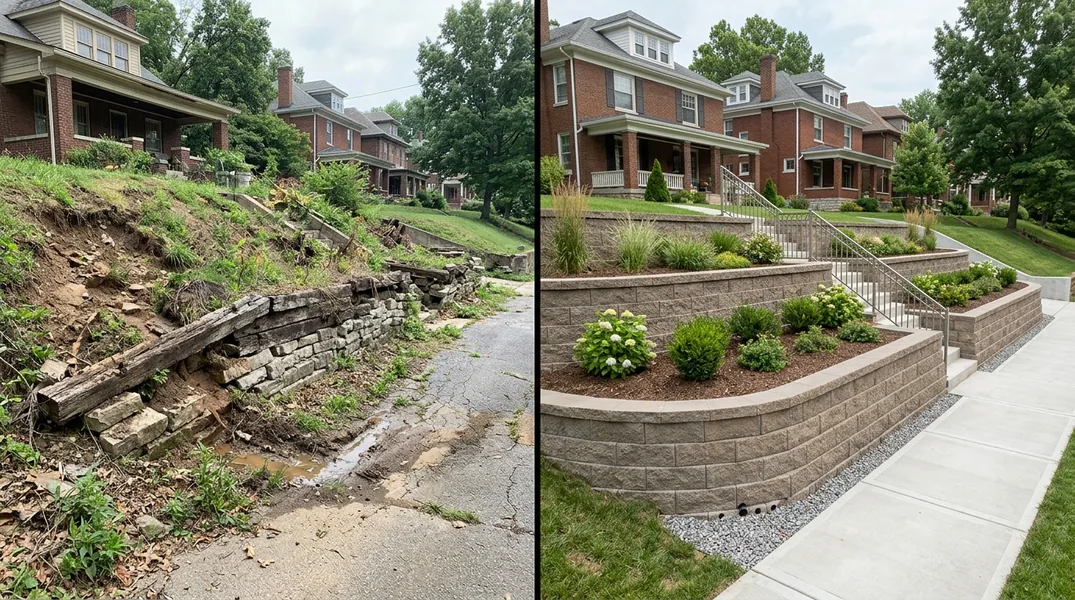
Why Louisville's Spring Rains Are Hard on Retaining Walls
Spring in Louisville brings lush green lawns and blooming trees, but it also delivers weeks of steady rain and sudden downpours. All that water has to go somewhere, and if your retaining wall was built without proper drainage, it goes directly into the soil behind the wall. That soil becomes saturated, heavy, and expansive, pushing against the back of the wall with tremendous force. This is the beginning of most retaining wall failures we see in the area.
Homeowners often assume a wall is failing because of age or poor construction, but in many cases the structure itself was fine. The real culprit is water that had no escape route. Understanding how drainage works, and what happens when it fails, can help you spot warning signs early and avoid a costly collapse. If you are already seeing movement or bulging, Retaining Wall Repair may be needed before the problem worsens.
Hydrostatic Pressure: The Silent Force Behind Wall Failure
When water saturates the soil behind a retaining wall, it creates hydrostatic pressure. Think of it as a growing weight pressing outward against the wall, increasing with every inch of rain. Most residential retaining walls are designed to handle the weight of soil, but they are not designed to hold back a reservoir of water. Once hydrostatic pressure builds, the wall begins to lean, crack, or bow outward. In severe cases, the entire face can shear off or topple.
This pressure does not disappear when the rain stops. Clay-heavy soils common in the Louisville area can hold moisture for days or weeks, keeping constant stress on the wall. Over time, even a well-built wall can fail if that pressure is not relieved. The solution is not a thicker wall or stronger blocks alone. It is a drainage system that collects water and moves it away from the structure before pressure can build.
How a Retaining Wall French Drain Prevents Costly Damage
A retaining wall french drain is the most reliable way to manage water behind a wall. It typically consists of a perforated pipe wrapped in filter fabric and surrounded by washed gravel, installed at the base of the wall footing. Water flows into the pipe and is directed to a safe discharge point, such as a storm drain, dry well, or daylighted slope. This keeps the soil behind the wall from becoming saturated and relieves hydrostatic pressure before it can cause movement.
Proper drainage also includes gravel backfill, filter fabric to prevent soil from clogging the pipe, and weep holes that allow any remaining moisture to escape through the wall face. When these components are designed correctly, the wall stays dry, stable, and strong through even the wettest spring. When they are missing or poorly installed, failure is only a matter of time. If you are planning a new wall, make sure your contractor includes a drainage plan in the scope of work for Retaining Wall Installation.
Signs Your Retaining Wall Drainage Is Already Failing
Homeowners in St. Matthews and across the metro should watch for a few key warning signs. Water pooling at the base of the wall after rain, soil washing out from between blocks, or white mineral stains on the wall face all point to drainage problems. You may also notice the wall leaning slightly, cracks widening over time, or the ground behind the wall settling. Any of these signs mean water is not being managed properly.
Ignoring these warnings usually leads to bigger problems. A small drainage issue can turn into a structural failure after one heavy storm, and repairs become much more involved. In some cases, the best path forward is Retaining Wall Replacement with a properly engineered drainage system. A professional inspection can tell you whether your wall can be repaired or should be replaced. Call (502) 442-0464 to schedule an assessment before the next round of spring storms arrives.
Choosing the Right Materials for Wet Conditions
Material choice matters when drainage is a concern. Concrete Retaining Walls are highly resistant to moisture and do not degrade when exposed to repeated wetting and drying cycles. Segmental block walls can also perform well when built with proper drainage, but they depend heavily on correct installation. Wood walls are the most vulnerable in wet conditions and tend to rot and warp when water is not controlled.
Regardless of material, the drainage system is what determines long-term performance. A concrete wall with no drainage can still fail under hydrostatic pressure, while a well-drained block wall can last for decades. The key is to match the material to the site conditions and to install a drainage system designed for the soil type and slope. Homeowners in Jeffersontown and Shively often deal with clay soils that drain slowly, making a french drain especially important.
Protecting Your Investment: What to Ask Before You Build
Before hiring a contractor, ask how they plan to handle water behind the wall. A qualified installer should explain the drainage design, including pipe size, gravel type, filter fabric, and where water will discharge. They should also discuss soil conditions and whether a geogrid reinforcement is needed. If a contractor cannot explain the drainage plan clearly, that is a red flag. Proper drainage is not an optional add-on; it is a core part of the structure.
It also helps to understand pricing before work begins, since drainage components add cost but prevent much larger expenses later. A wall that fails because of poor drainage can cost far more to replace than a properly drained wall costs to build. If you want a clear free estimate with a drainage plan included, reach out to Louisville Retaining Wall at (502) 442-0464. Protecting your wall from water is the best way to ensure it stands strong through every Louisville spring.
Looking for a professional retaining wall contractor in Louisville? Louisville Retaining Wall responds fast for all your retaining wall needs.
Get a Free QuoteOur services: Retaining Wall Installation · Retaining Wall Repair · Retaining Wall Replacement