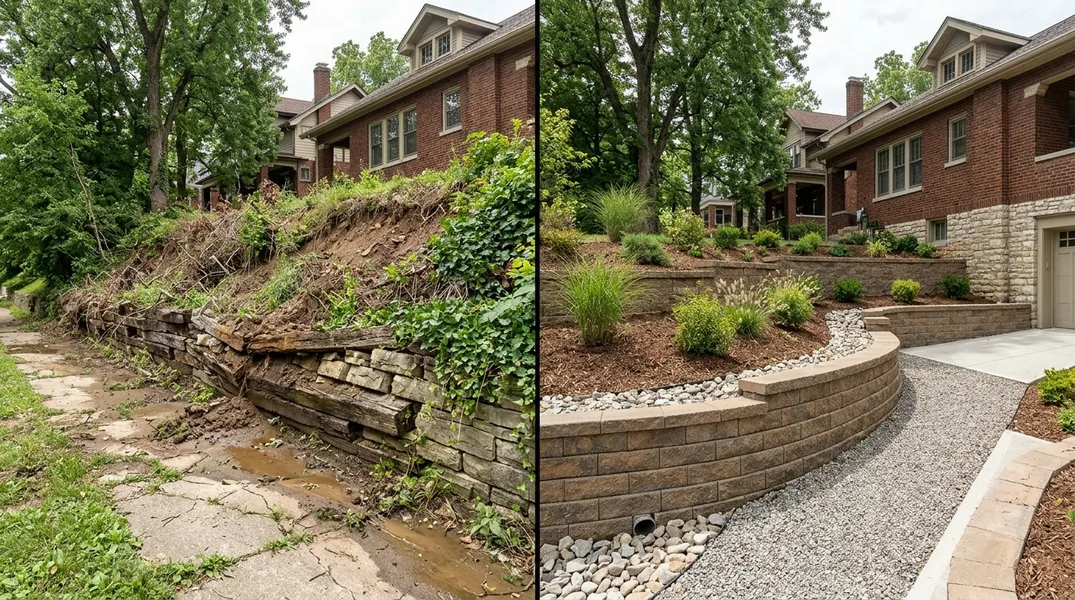
Why Retaining Walls Lean in Louisville's Soil and Climate
A leaning retaining wall is rarely a cosmetic issue. In Louisville, the combination of clay-heavy soil and seasonal freeze-thaw cycles puts constant pressure on retaining structures. When water saturates the soil behind a wall, it adds tremendous weight, and if drainage is inadequate, that water has nowhere to go but against the wall face. Over time, the wall begins to tilt forward, and what started as a small gap at the top can become a serious safety concern.
Many homeowners first notice the problem after a heavy spring rain or a hard winter freeze. Cracks appear along the mortar joints, the capstones shift, or the entire wall leans noticeably. Ignoring these signs usually makes the problem worse, because the forces causing the lean do not go away on their own. The good news is that not every leaning wall needs to be torn out. Understanding the cause is the first step toward deciding whether Retaining Wall Repair is enough or whether a full rebuild is the safer choice.
Signs That Retaining Wall Repair May Be Enough
If the lean is minor and recent, and the wall is still structurally sound, repair is often the most cost-effective path. Small cracks, a slight tilt of a few inches, or localized settling at one section can frequently be addressed by improving drainage, resetting capstones, and reinforcing the affected area. The key is catching the problem early, before the wall's foundation or the soil behind it has shifted significantly. A professional assessment can determine whether the wall's core structure is intact.
Retaining wall crack repair is especially effective when the cracks are hairline or limited to the surface. In many cases, the underlying issue is water management rather than a failed wall. Adding proper drainage, such as weep holes or a French drain system, can relieve pressure and stop further movement. If your wall is showing only early warning signs, a targeted repair can extend its life by years and save you the expense of a full replacement. It is always worth getting a free estimate before assuming the worst.
When Retaining Wall Replacement Is the Safer Choice
Some walls are simply past the point of repair. If the wall has leaned significantly, if large sections have separated, or if the foundation has failed, patching it may only delay a collapse. A wall that is holding back a steep slope or supporting a driveway or patio poses a real risk to people and property. In these cases, Retaining Wall Replacement is the responsible decision, and it often costs less over time than repeated repairs.
Modern replacement walls are built with better materials and drainage than many older structures. If your current wall is made of aging timber or unreinforced block, upgrading to Concrete Retaining Walls can provide decades of reliable performance. A proper replacement also includes a redesigned drainage system and compacted base, which addresses the root cause of the lean rather than just the symptom. For homeowners in neighborhoods like St. Matthews, where mature landscaping and sloped lots are common, a well-built replacement wall can also improve curb appeal and usable yard space.
Leaning Retaining Wall Repair Near Me: How to Choose a Contractor
When you search for leaning retaining wall repair near me, you will find plenty of options, but not all contractors are equipped to diagnose structural problems. A qualified installer will inspect the wall's base, evaluate soil conditions, check drainage, and explain whether repair or replacement is the right call. They should also be able to show you examples of similar projects and provide a written scope of work. In a city like Jeffersontown, where lots vary widely in slope and soil, local experience matters.
Ask potential contractors how they handle water management, what materials they recommend, and whether they offer any warranty on labor and materials. Be cautious of anyone who recommends a full rebuild without explaining why, or who suggests a quick patch without addressing drainage. A trustworthy professional will give you a clear, honest assessment and a detailed pricing breakdown so you can compare options. You can also call Louisville Retaining Wall at (502) 442-0464 to discuss your wall and schedule an inspection.
What to Budget for Repair or Replacement in Louisville
Costs vary based on the wall's height, length, materials, and accessibility, but homeowners should expect repair to be significantly less expensive than replacement when the damage is minor. A small crack repair or drainage improvement might be a few hundred dollars, while rebuilding a large wall can run into the thousands. The important thing is to get a professional opinion before spending money on cosmetic fixes that will not solve the underlying problem. Delaying a necessary replacement often leads to higher costs later.
If you are unsure which route makes sense, start with an inspection. A contractor can tell you whether your wall is a candidate for repair or whether replacement is the safer investment. For homeowners in areas like Shively, where older walls are common, this assessment can prevent a small issue from becoming a major expense. Contact Louisville Retaining Wall at (502) 442-0464 or request a free estimate to get clear answers and a plan that fits your budget.
Looking for a professional retaining wall contractor in Louisville? Louisville Retaining Wall responds fast for all your retaining wall needs.
Get a Free QuoteOur services: Retaining Wall Installation · Retaining Wall Repair · Retaining Wall Replacement