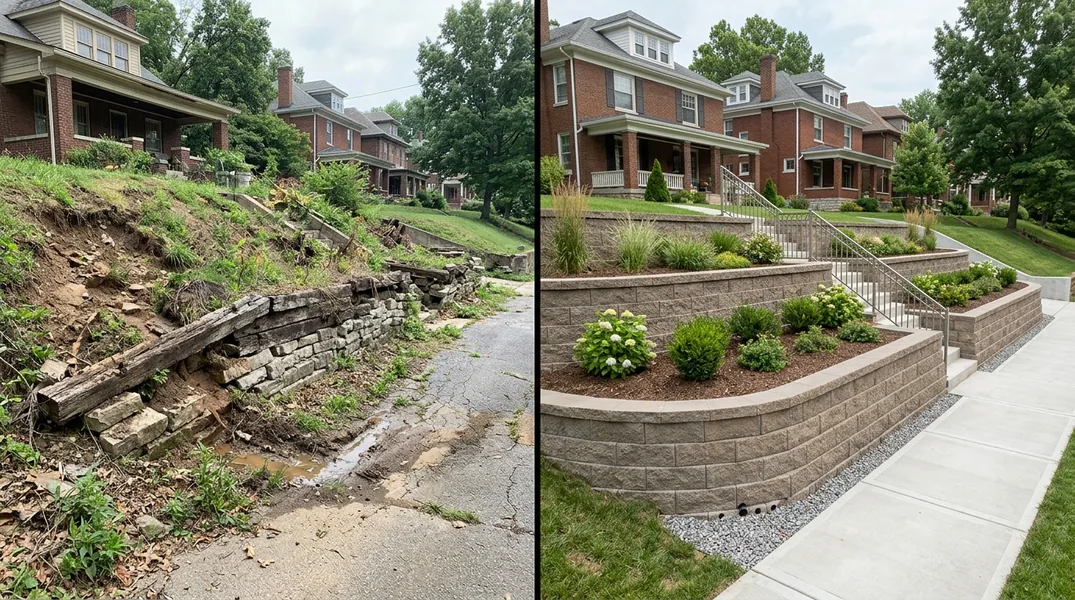
Why Louisville's Soil Is Tough on Retaining Walls
If you live in Louisville, you already know that our landscape is anything but flat. The rolling hills and knobs that give this region its character also create serious challenges for any structure that has to hold back soil. The culprit is clay, and a lot of it. Louisville's clay-rich soil expands when it absorbs water and contracts as it dries, a cycle that repeats with every heavy rain and summer dry spell. That constant swelling and shrinking puts enormous pressure on retaining walls, far more than the sandy or rocky soils found in other parts of the country.
When a wall is designed and built without accounting for this movement, the soil does not just push against it once and stop. It works on the wall season after season, gradually loosening joints, shifting footings, and opening paths for water to get behind the structure. Homeowners in neighborhoods like St. Matthews and Jeffersontown often see the first signs within a few years of installation if the original build did not include proper drainage and base preparation. Understanding this soil behavior is the first step toward protecting your property and knowing when a leaning retaining wall needs professional attention.
The Most Common Reasons Retaining Walls Fail Here
Most failing walls in our area share a handful of root causes. The number one issue is poor drainage. When water cannot escape from behind a wall, it saturates the clay backfill, and that saturated soil becomes incredibly heavy. Hydrostatic pressure builds up and pushes the wall forward, which is exactly how a bowing retaining wall starts. A properly built wall includes gravel backfill, a drainage pipe, and weep holes to move water away, but many older or DIY walls skip these steps entirely. Without them, even a sturdy-looking wall can begin to lean within a few seasons.
The second major cause is an inadequate base or footing. Clay soil shifts, and if the wall's foundation is too shallow or not compacted correctly, the entire structure can settle unevenly. This is especially common on sloped lots in Shively and other hilly parts of town. Finally, some walls simply are not engineered for the load they carry. A wall holding back four feet of saturated clay needs more strength than many homeowners realize, and using the wrong materials or skipping reinforcement leads to premature failure. If you are seeing the results of any of these problems, Retaining Wall Repair can often address the damage before a full rebuild is needed.
Warning Signs: How to Spot a Failing Retaining Wall
Your wall will usually tell you something is wrong long before it collapses. The most visible sign is a lean. Step back and look at the wall from the end; if the top is tipping away from the soil it holds, that is a clear red flag. A bowing wall, where the middle bulges outward, is another serious indicator of pressure buildup. Cracks are equally important. Hairline cracks may be cosmetic, but widening cracks, especially horizontal ones, suggest the wall is being pushed apart. You should also watch for soil settling or sinking behind the top of the wall, which can signal that backfill is washing away.
Other warning signs are less obvious but just as telling. Look for water pooling at the base of the wall after rain, or white mineral stains on the face, both of which point to drainage failure. Bulging or separation in individual blocks or panels means the connections are giving way. If you notice any of these issues, do not wait for the next heavy storm to make things worse. A quick free estimate from a professional can tell you whether the problem is minor or a sign that the wall is close to failing. Catching a leaning retaining wall early usually means a simpler, less expensive fix.
Retaining Wall Repair Near Me: When to Call a Pro
Some homeowners try to patch a failing wall themselves, but retaining walls are structural systems, and small fixes rarely solve the underlying problem. If the wall is leaning, bowing, or showing significant cracks, it is time to bring in an experienced contractor. A professional will evaluate the soil, the drainage, and the wall's construction to determine whether a targeted repair will hold or whether the wall needs to be rebuilt. In many cases, Retaining Wall Replacement is the smarter long-term investment, especially when the original wall was built without proper drainage or reinforcement.
For walls that are still sound but need attention, options like Concrete Retaining Walls can offer a durable, low-maintenance solution that handles clay soil better than many alternatives. The key is getting an honest assessment rather than guessing. If you are searching for retaining wall repair near me and want a straight answer about what your wall needs, call Louisville Retaining Wall at (502) 442-0464. We serve homeowners across the area and can help you decide whether repair or replacement makes the most sense for your property and budget.
Protecting Your Investment for the Long Run
The best defense against wall failure is a proper build from the start. That means a base that extends below the frost line, gravel backfill, a functioning drainage system, and materials rated for the load. When Retaining Wall Installation is done correctly, a wall can last for decades even in our challenging clay soil. Homeowners who are planning a new wall should ask about drainage details and base preparation before work begins, because those are the areas where shortcuts cause the most trouble later.
Maintenance also matters. Keep an eye on the wall after heavy rains, make sure weep holes stay clear, and address small cracks before they grow. If you are unsure about your wall's condition, a professional inspection is a small price to pay for peace of mind. For questions about pricing or to schedule a visit, reach out to Louisville Retaining Wall at (502) 442-0464. Our team knows the local soil, the local slopes, and the warning signs that matter, and we are here to help you keep your wall standing strong for years to come.
Looking for a professional retaining wall contractor in Louisville? Louisville Retaining Wall responds fast for all your retaining wall needs.
Get a Free QuoteOur services: Retaining Wall Installation · Retaining Wall Repair · Retaining Wall Replacement